

- 13/01/2021
- Dr. Ashwini Gaurav
- 0 Comments
- Uncategorized
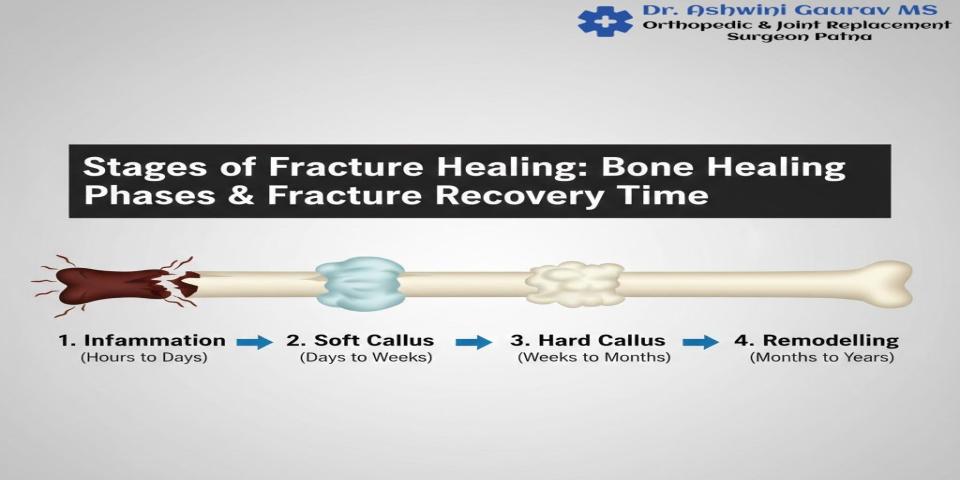
Stages of Fracture Healing: Bone Healing Phases & Fracture Recovery Time
Introduction to Fractures and Healing
Dealing with a broken bone can be a painful and frustrating experience. Whether it’s a minor hairline crack or a major break, the first question everyone asks is: “How long will this take to get better?” Understanding the process of bone healing can help you manage your expectations and ensure you are doing everything possible to speed up your recovery. In this comprehensive guide, we will walk through the stages of fracture healing, the factors that influence your fracture bone recovery time, and how an Orthopedic expert like Dr. Ashwini Gaurav can help you get back on your feet.
Fractures and healing go hand-in-hand as a testament to the body’s incredible ability to repair itself. A fracture occurs when a force applied to the bone is stronger than the bone itself, resulting in a break. While a break might seem like a permanent change, bone is one of the few tissues in the human body that can heal without leaving a scar. Instead, it regenerates new bone tissue that is often just as strong as the original. The healing of fracture involves a complex biological sequence that starts the very second the injury occurs.
Stages of Fracture Healing
The fracture healing stages are generally divided into three main biological phases, which can be further broken down into specific steps.
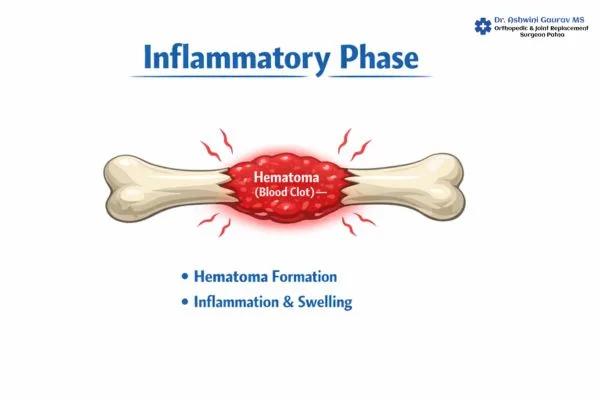
1. Inflammatory Phase of Fracture Healing
This is the first stage of fracture healing. Immediately after the break, the body sends signals to start the repair.
- Hematoma Formation: A blood clot (hematoma) forms around the break.
- Inflammation: You will notice swelling and redness. This is the body’s way of “cleaning” the area by removing damaged bone fragments and germs.
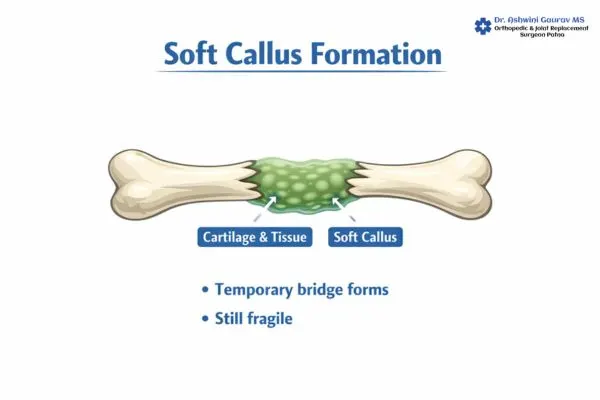
2. Soft Callus Formation Stage
Within 2 to 3 weeks, the healing fracture enters the reparative phase. The body begins to replace the blood clot with cartilage and tissue called a “soft callus.” This acts as a temporary bridge between the broken ends, though it is still quite fragile.
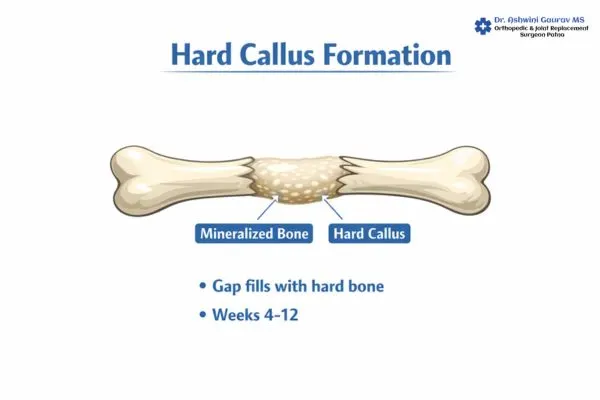
3. Hard Callus Formation Stage
This is a crucial healing bone process where the soft cartilage is replaced by hard, mineralized bone (hard callus). On an X-ray, this is when the doctor starts to see the “gap” filling in. This usually happens between week 4 and week 12.
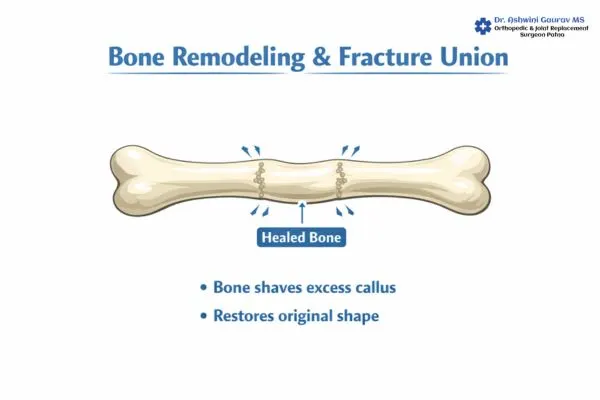
4. Bone Remodeling and Fracture Union
The final fracture healing bone stage is remodeling. The body “shaves off” the extra bone growth and restores the bone to its original shape and strength. This phase can continue for months or even years after the fracture union time.
4 Stages vs 6 Stages of Fracture Healing
In the medical world, the phases of fracture healing are sometimes described differently depending on how detailed the breakdown is.
- 4 Stages of Bone Healing: This is the simplified version: 1. Hematoma, 2. Soft Callus, 3. Hard Callus, and 4. Remodeling.
- 6 Stages of Fracture Healing: This is a more clinical view: 1. Impact, 2. Induction, 3. Inflammation, 4. Soft Callus, 5. Hard Callus, and 6. Remodeling.
Regardless of the terminology, the stages bone healing follows the same biological path to ensure the fracture bone recovery is complete.
Healing Time for Different Types of Fractures
The time for bone healing varies significantly based on which bone you broke.
- Femur Bone Break Healing Time: The femur (thigh bone) is the strongest bone in the body. Healing can take 4 to 6 months because of the weight it must carry.
- Fracture Leg Recovery Time: A standard tibia/fibula break usually takes 3 to 4 months for initial recovery.
- Crack Bone Healing Time: A small “stress fracture” or cracked bone healing time is much shorter, often 6 to 8 weeks, provided the area is rested properly.
Factors Affecting Fracture Bone Recovery Time
Why do some people heal faster than others? Several factors influence the healing time of fracture:
- Age: Children heal much faster than adults because their bones are still actively growing.
- Nutrition: Lack of Calcium, Vitamin D, and Protein can delay the process of bone healing.
- Smoking: Nicotine constricts blood vessels, slowing down the blood flow necessary for healing of fracture stages.
- Medical Conditions: Diabetes or osteoporosis can significantly increase the fracture healing period.
- Severity: A “displaced” fracture (where bones moved) takes longer to heal than a non-displaced one.
How to Heal a Fractured Bone Fast
While you can’t skip the steps of bone healing, you can certainly optimize them. To heal bone fracture fast, follow these tips:
- Immobilization: Stick strictly to your cast or brace instructions. Movement in the early stages can break the delicate soft callus.
- No Smoking: Avoid tobacco at all costs during your fracture recovery.
- Safe Movement: Follow the physiotherapy exercises recommended by your doctor to maintain blood circulation.
- Protein Intake: Bone is made of a protein matrix (collagen). Ensure you are eating enough protein.
Indian Food for Bone Fracture Healing
In India, we have a wealth of traditional foods that provide the perfect nutrients for the healing of fracture.
- Dairy Products: Milk, Paneer, and Curd are rich in Calcium.
- Ragi (Finger Millet): This is one of the best sources of calcium in the Indian diet.
- Moringa (Drumstick): High in calcium and phosphorus.
- Dal and Legumes: Essential for the protein required during the bone recovery time.
- Turmeric Milk (Haldi Doodh): Known for its anti-inflammatory properties, it helps during the initial stage of fracture healing.
Fracture of Bone Treatment Options
The fracture of bone treatment depends on the location and severity:
- Casting/Bracing: For simple breaks that are still aligned.
- Reduction: When a doctor manually “sets” the bone back into place.
- Internal Fixation: Surgery using plates, screws, or rods (common for femur bone break).
- External Fixation: Metal pins placed outside the skin to hold the bone in place.
Will Broken Bones Heal on Their Own?
A common question is: “Will broken bones heal on their own?”
The answer is yes, the body will try to heal itself. However, without medical intervention, the bone may heal in a crooked position (malunion) or fail to join at all (non-union). This can lead to permanent disability or chronic pain. Professional treatment ensures the bone heals in the correct alignment.
Signs of a Healed Fracture
How do you know you have a healed fracture?
- Zero Pain: You can put pressure on the limb without discomfort.
- Range of Motion: You can move the nearby joints freely.
- X-Ray Confirmation: Your orthopedic surgeon sees a solid “hard callus” on the scan.
- Restored Strength: The muscle around the bone begins to feel strong again.
Dr. Ashwini Gaurav – Your Partner in Fracture Recovery
When it comes to complex fractures, you need an expert who understands the nuances of the bone healing phases. Dr. Ashwini Gaurav is a renowned orthopedic specialist dedicated to helping patients navigate their fracture recovery time with ease.
With a focus on advanced treatment methods and personalized care, Dr. Ashwini Gaurav ensures that your fracture healing stages progress smoothly, minimizing the risk of complications and helping you return to your normal life as quickly as possible.
Conclusion of Fracture Healing
The conclusion of fracture recovery is not just about the bone knitting back together; it is about regaining your mobility and quality of life. By understanding the stages of healing fracture—from the initial inflammation to the final remodeling—you can stay patient and disciplined with your treatment.
Proper nutrition, avoiding bad habits, and following expert medical advice are the keys to a successful fracture and recovery journey.
📲 Contact Dr Ashwivi Gaurav
✔️ Visit Jivandan Hospital in Patna
FAQs: About Stages of Fracture Healing
The process of bone healing is a natural regenerative journey that the body undergoes after a fracture. According to Dr. Ashwini Gaurav, a leading Orthopaedic Surgeon in Patna, bone healing typically follows these 4 primary stages:
- Inflammation & Hematoma Formation (Days 1–5): Immediately after a break, a blood clot (hematoma) forms around the fracture to provide initial stability and deliver immune cells.
- Soft Callus Formation (Week 2–3): The body creates a bridge of cartilage and fibrocartilage between the broken bone ends.
- Hard Callus Formation (Week 4–12): The soft cartilage is replaced by hard, mineralised bone, which is visible on X-rays.
- Bone Remodeling (Months to Years): The final stage where the bone regains its original shape, strength, and blood circulation.
Dr. Ashwini Gaurav simplifies the biological healing process into four main phases:
- Hematoma Formation (Day 1-5): Inflammation and blood clotting.
- Fibrocartilaginous Callus (Week 2-3): Formation of soft tissue “bridge.”
- Bony Callus Formation (Week 4-12): Hard bone replaces the soft callus.
- Bone Remodeling (Months-Years): The bone reaches its final, mature state.
The fracture recovery time varies based on the bone’s location. Dr. Ashwini Gaurav provides this general timeline:
- Stress/Crack Fractures: 6 to 8 weeks.
- Arm/Wrist Fractures: 6 to 10 weeks.
- Leg (Tibia) Fractures: 3 to 4 months.
- Thigh Bone (Femur) Fractures: 4 to 6 months.
Dr. Ashwini Gaurav identifies two primary types of bone healing:
- Primary (Direct) Healing: Occurs when surgery (plates and screws) aligns the bone perfectly, allowing it to heal without a “callus.”
- Secondary (Indirect) Healing: The most common type, where the body forms a “callus” or bone bridge, typically seen with plaster casts.
While bone healing is often simplified, Dr. Ashwini Gaurav—Patna’s leading Orthopaedic Surgeon—explains that the complete clinical recovery process actually involves 6 distinct biological stages:
- Impact Phase: This is the immediate moment the injury occurs and the bone sustains the fracture.
- Induction Phase: Within hours, the body triggers specialized cells (osteoblasts) to begin the process of creating new bone.
- Inflammation Phase: A blood clot (hematoma) forms around the break to provide a framework for healing and to clear away damaged tissue.
- Soft Callus Phase: Around 2 to 3 weeks post-injury, the body creates a bridge of cartilage (fibrocartilage) to connect the broken ends.
- Hard Callus Phase: Between 4 to 12 weeks, the soft cartilage is replaced by hard, mineralized bone that is visible on X-rays.
- Remodeling Phase: The final stage, where the bone is reshaped to its original strength and contour. This can last from several months to a few years
