

- 04/03/2026
- Dr. Ashwini Gaurav
- 0 Comments
- Blog
Joint Effusion (Swollen Joint): Definition, Meaning, Causes, and Treatment for Knee Effusion
Have you ever woken up to find your knee looking twice its normal size? Or perhaps you’ve heard people talking about having “water on the knee” and wondered what that actually means?
So many people search for terms like what is joint effusion or joint effusion means when they notice sudden, painful swelling. If you are dealing with a swollen knee joint, you aren’t alone. Understanding this condition is the first step toward getting back on your feet.
In this guide, we will break down everything you need to know about joint and knee effusion, with expert insights from Dr. Ashwini Gaurav. With over 15 years of experience, Dr. Gaurav is a renowned Director and Head of Orthopaedic & Joint Replacement Surgery at Jeevandan Health OPD. He is widely recognized as the Best Orthopaedic Doctor in Patna, Bihar, India, helping thousands of patients recover from complex joint issues.
What Is Joint Effusion?
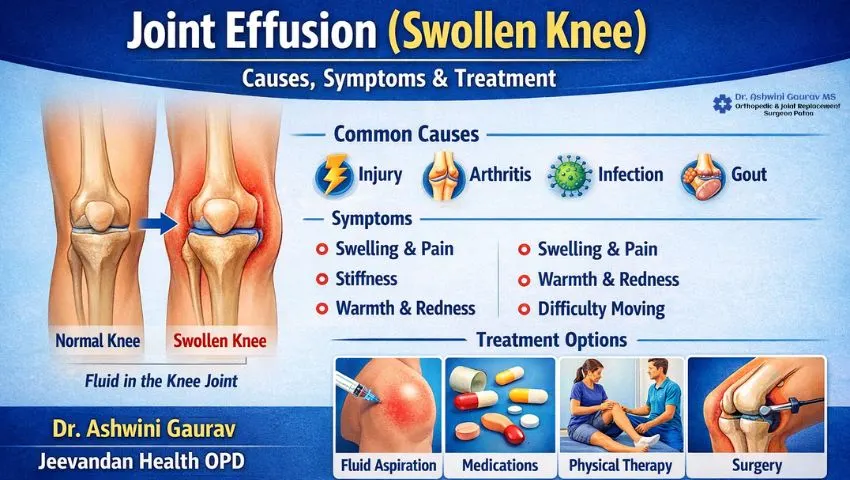
To put it simply, joint effusion meaning refers to the abnormal buildup of extra fluid in or around a joint. While our joints naturally contain a small amount of synovial fluid to stay lubricated and move smoothly, an injury or disease can cause the body to produce too much.
A joint effusion definition usually describes this as “swelling” where the fluid gets trapped in the joint capsule. While it can happen in the ankles or elbows, it is most common in the knees.
What Is Knee Effusion?
Knee effusion (often called effusion of knee) is when that excess fluid accumulates specifically in the knee joint. This is the “puffiness” you feel when your kneecap seems to be floating or when one knee looks significantly larger than the other.
In medical terms, you might hear your doctor mention knee joint effusion. Whether it is a mild joint effusion, a moderate knee effusion, or a minimal knee effusion, the underlying cause needs to be identified to treat it correctly.
Symptoms of Joint Effusion:
Identifying knee effusion symptoms early can prevent long-term damage. Common signs of fluid in knee joint include:
- Visible Swelling: Your swollen knee joint looks “puffy” compared to the other.
- Stiffness: You find it hard to fully bend or straighten your leg.
- Pain: A dull ache or sharp pain, especially when putting weight on it.
- Warmth and Redness: The skin around the knee might feel hot to the touch.
- Heaviness: A feeling like there is “water in the knee.”
Causes of Joint Effusion of the Knee:
There are many causes of knee effusion, ranging from a minor strain to serious medical conditions. The most common knee effusion causes include:
- Trauma or Injury: A torn ligament (like an ACL), meniscus tear, or broken bone can trigger a sudden joint effusion of knee.
- Overuse: Repetitive motions from sports or work can lead to synovitis knee (inflammation of the joint lining).
- Arthritis: Osteoarthritis and rheumatoid arthritis are leading reasons for chronic swelling in knee joint.
- Infections: Bacteria entering the joint can cause rapid fluid accumulation in knee.
- Gout: Uric acid crystals can irritate the joint, leading to knee fluid buildup.
How Joint Effusion Is Diagnosed At Jeevandan Health Hospital?
At Jeevandan Health Hospital, we believe in a “diagnosis first” approach. To find out why you have minimal joint effusion in knee or more severe swelling, Dr. Ashwini Gaurav uses advanced tools:
- Physical Exam: Checking for the “ballotable patella” (a floating kneecap) and range of motion.
- Imaging: X-rays or MRI scans to check for fractures or ligament tears.
- Joint Fluid Analysis: Using a needle to take a small sample of the synovial fluid in knee to check for infection or gout crystals.
- Ultrasound: To identify specific areas of fluid, such as suprapatellar effusion (fluid above the kneecap).
Joint Effusion Treatment by Dr. Ashwini Gaurav:
The treatment for knee effusion depends entirely on what is causing the “water.” Dr. Ashwini Gaurav provides personalized knee joint effusion treatment plans:
- Arthrocentesis (Aspiration): Removing the knee fluid with a needle to provide immediate pressure relief.
- Medication: Anti-inflammatory drugs or antibiotics if an infection is present.
- Injections: Corticosteroids to reduce heavy inflammation.
- Physical Therapy: Specialized exercises to strengthen the muscles around the knee.
- Surgery: In severe cases, such as a major tear or advanced arthritis, Dr. Gaurav may recommend arthroscopy or joint replacement.
When to See the Best Orthopedic Doctor for a Swollen Joint?
You should not ignore a mild joint effusion knee. While some swelling goes away with rest, you must consult the Best Orthopaedic Doctor in Patna if:
- You cannot put any weight on your leg.
- The knee is red and you have a fever (this could be an emergency infection).
- The swelling does not go down after 3 days of home care.
- You felt a “pop” during an injury.
Prevention Tips for Knee Effusion:
While you can’t avoid every accident, you can protect your joints:
- Maintain a Healthy Weight: Less weight means less pressure and less fluid accumulation in knee.
- Strengthen Your Quads: Strong thigh muscles support the joint better.
- Low-Impact Exercise: Choose swimming or cycling over high-impact running if you have sensitive joints.
- Listen to Your Body: If your knee aches, rest it before it turns into moderate knee effusion.
Conclusion:
A swollen knee joint is your body’s way of saying something is wrong. Whether it’s minimal knee effusion or painful water on the knee symptoms, getting an expert opinion early is the key to a fast recovery.
With the right water on the knee treatment and care from an experienced specialist like Dr. Ashwini Gaurav at Jeevandan Health OPD, you can return to your active lifestyle without pain.
➢ Book an Appointment with Dr. Ashwini Gaurav
➢ Contact no – 7070828777 / 9386737895
FAQs About Joint Effusion:
Synovial fluid in knee acts like “engine oil” for your joints. If it decreases, you feel stiffness. You can improve the quality and flow of this knee fluid through these natural methods:
- Stay Hydrated: Synovial fluid is largely made of water. Drinking 3–4 liters of water daily is the simplest way to keep joints lubricated.
- Healthy Fats (Omega-3): Eat walnuts, flaxseeds, chia seeds, and fatty fish. These reduce inflammation and support fluid health.
- Specific Foods: Consuming extra virgin olive oil and avocados can help maintain the “grease” in your joints.
- Movement: Light movement, like walking or cycling, helps circulate the fluid in knee joint. Think of it as “motion is lotion.”
- Supplements: Under the guidance of Dr. Ashwini Gaurav, supplements like Glucosamine or Chondroitin may be suggested to support the joint environment.
If you have mild joint effusion, you can manage the swelling in knee joint at home using the R.I.C.E. method:
- Rest: Avoid heavy lifting or long periods of standing to prevent further fluid accumulation in knee.
- Ice: Apply an ice pack for 15–20 minutes every 3 hours. This is highly effective for water on the knee treatment as it shrinks blood vessels and reduces fluid buildup.
- Compression: Use an elastic crepe bandage or a knee cap. This prevents extra knee fluid from gathering around the kneecap.
- Elevation: Keep your leg raised on two pillows while lying down. This helps gravity drain the effusion of knee back toward the heart.
- Turmeric Milk: Turmeric contains curcumin, which is a natural anti-inflammatory that helps reduce synovitis knee.
To truly “cure” the swelling, you must treat the causes of knee effusion. Here is the step-by-step approach:
- Identify the Cause: Is it an injury, gout, or arthritis? A proper diagnosis at Jeevandan Health Hospital is the first step.
- Anti-Inflammatory Medication: Over-the-counter medicines (NSAIDs) can reduce the pain of a swollen knee joint.
- Aspiration: If the swelling is severe (moderate knee effusion), a doctor might need to “drain” the water in knee using a sterile needle.
- Physiotherapy: Strengthening the quadriceps and hamstrings takes the pressure off the joint, preventing future joint effusion of knee.
- Weight Management: Reducing body weight significantly lowers the stress that leads to knee effusion.
“Increasing knee fluid” usually means improving the quality of lubrication rather than just the volume.
- Hyaluronic Acid Foods: Eat root vegetables (like sweet potatoes) and leafy greens.
- Low-Impact Exercise: Swimming is excellent because it allows the joint to move and produce synovial fluid without the stress of body weight.
- Medical Injections: If natural ways don’t work, Dr. Ashwini Gaurav might recommend Viscosupplementation (Hyaluronic acid injections) to directly add “cushion” back into the knee.
