

- 06/02/2022
- Dr. Ashwini Gaurav
- 0 Comments
- Joint Pain
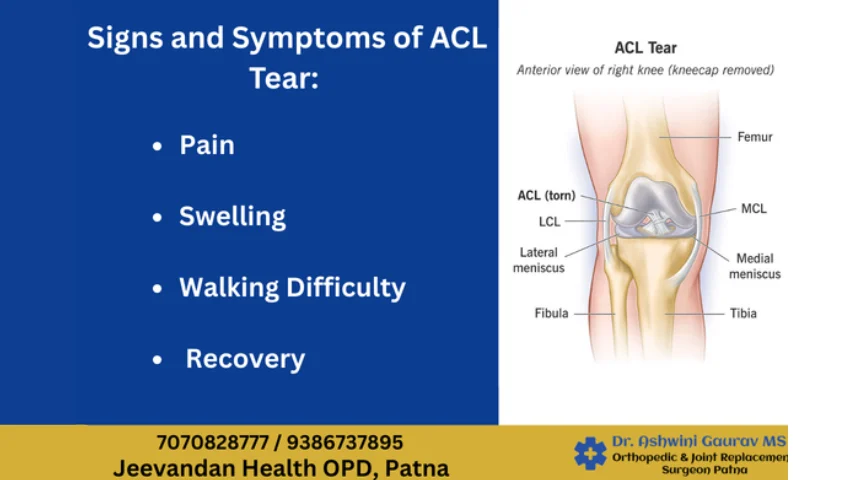
Signs and Symptoms of ACL Tear: Pain, Swelling, Walking Difficulty & Recovery
If you have ever felt a sudden “pop” in your knee while playing football, cricket, or even during a clumsy fall, you might be dealing with an ACL injury. An Anterior Cruciate Ligament (ACL) injury is one of the most common knee problems in India, affecting both athletes and active individuals.
In this guide, Dr. Ashwini Gaurav, a leading Orthopaedic specialist, explains everything you need to know about ACL tear symptoms, the recovery process, and whether you can walk with a torn ligament.
What Is ACL? Meaning, Definition & Location in the Knee
Understanding what is ACL starts with its full form: the Anterior Cruciate Ligament.
- ACL Meaning: It is one of the four major ligaments that connect your thigh bone (femur) to your shin bone (tibia).
- Where is the ACL located? It is situated deep inside the knee joint, crossing diagonally in the middle of the knee.
- Function: It prevents the tibia from sliding out in front of the femur and provides rotational stability to the acl of knee.
Where Is ACL Pain Located? Understanding ACL Pain Area
Many patients ask, “Where is acl pain felt?” because knee pain can be confusing.
- ACL pain location: The pain is usually felt deep inside the knee or behind the kneecap.
- Where does ACL hurt? While the initial sharp pain is central, it often radiates to the sides or the back of the knee as inflammation sets in.
- Pain with ACL injury: It is typically an “instability pain”—a sharp ache when you try to turn, pivot, or shift weight.
Common Signs and Symptoms of ACL Injury in the Knee
The symptoms of torn ACL often appear immediately, but some may develop over 24 hours. Watch out for these ruptured ACL symptoms:
- A loud “pop” or a “popping” sensation.
- Severe pain and inability to continue the activity.
- Rapid ACL swelling (within 2 to 6 hours).
- Loss of full range of motion (inability to straighten the leg).
- Tenderness along the joint line.
What Does a Torn ACL Feel Like? Pain, Popping & Instability
What does a torn ACL feel like? Most describe it as if the knee has become “loose” or “disconnected.”
- Does tearing an ACL hurt? Yes, the initial pain of ACL tear is often excruciating.
- R Popping: The “pop” isn’t just a sound; it is a physical sensation of the ligament snapping.
- The Instability: You will feel a “giving way” sensation, especially when trying to change directions while walking.
Can You Walk with a Torn ACL? Weight Bearing & Movement
A common myth is that if you can walk, you haven’t torn anything.
- Can you walk with a torn ACL? Yes, many people can walk in a straight line after the initial pain subsides.
- Can you put weight on a torn ACL? You might be able to bear weight, but the knee will feel unstable.
- Walking with torn ACL: It is dangerous to resume sports immediately, as the lack of a functional injury ACL can lead to further damage to the meniscus (cartilage).
Swelling, Bruising & Stiffness After ACL Injury
Does ACL tear swell?
Almost always. The ACL has its own blood supply; when it tears, blood fills the joint (hemarthrosis).
- Torn ACL without swelling: While rare, a partial tear of ACL might result in minimal swelling.
- Bruised ACL: You may notice bruising around the shin or calf a few days after the injury.
ACL Injury Grades: Sprain, Partial Tear & Complete Rupture
Not all ACL tears are the same. They are classified into:
- Grade 1 (ACL Sprain): The ligament is stretched but still provides stability.
- Grade 2 (Partial Tear of ACL): The ligament is partially torn and slightly loose.
- Grade 3 (Complete ACL Rupture): The ligament is split into two pieces. This is a complete tear of ACL and usually requires surgery for active individuals.
What to Do If You Have ACL Injury Symptoms?
Immediate Self-Care (RICE Protocol)
- Rest: Stop all sports activities.
- Ice: Apply ice for 20 minutes every 2 hours to manage ACL swelling.
- Compression: Use an elastic bandage.
- Elevation: Keep the knee above heart level.
ACL Rupture Treatment Options
- Non-Surgical: Physiotherapy and bracing (for low-demand patients).
- ACL Surgery: Ligament reconstruction knee recovery time is usually 6–9 months. This involves using a graft to repair ACL.
- ACL Rupture Recovery Time: * Walking without crutches: 2–4 weeks.
- Jogging: 3–4 months.
- Return to sports: 9–12 months.
Consult Dr. Ashwini Gaurav for Knee ACL Injury Treatment
If you have suffered a knee muscle tear or suspect a tear in the knee ligament, do not ignore the ACL soreness. Early diagnosis is key to a faster recovery from ACL injury.
Dr. Ashwini Gaurav specializes in advanced ACL knee surgery and sports medicine, helping patients achieve the best recovery time for complete ACL tear.
Take the first step towards walking pain-free! Would you like to book a consultation to discuss your MRI reports or knee pain?
FAQ: ACL Injury
The Anterior Cruciate Ligament (ACL) is one of the four main ligaments in your knee.
- Where is the ACL located? It is located deep inside the knee joint, crossing diagonally to connect the femur (thigh bone) to the tibia (shin bone).
- What does the ACL do? It acts as the primary stabilizer of the knee, preventing the shin bone from sliding out in front of the thigh bone and providing rotational stability during pivoting movements.
Identifying a tear immediately after an accident is crucial. Dr. Ashwini Gaurav suggests looking for these “Big Three” signs:
- The “Pop”: Hearing or feeling a loud “popping” sensation inside the knee.
- Rapid Swelling: The knee typically swells significantly within 2 to 6 hours (hemarthrosis).
- Instability: A feeling that the knee is “giving way” or is too loose to support your weight.
Other symptoms of an ACL injury in the knee include:
- Loss of full range of motion (inability to fully straighten or bend the leg).
- Tenderness along the joint line.
- Deep, aching pain.
A torn ACL feels like a sudden, structural failure of the knee. Patients often describe it as if the upper and lower parts of the leg shifted apart for a split second. Initially, it feels like a sharp, stabbing pain, which later settles into a dull, throbbing ache combined with a sensation of the knee being “unreliable.
Yes, tearing an ACL is generally very painful at the moment of injury.
- How painful is an ACL tear? On a scale of 1–10, most patients rate the initial tear between an 8 and 10.
- Does a torn ACL hurt all the time? Surprisingly, the intense pain often subsides after a few days, but the “pain of instability” remains when you try to change directions or walk on uneven ground.
According to Dr. Ashwini Gaurav, a complete ACL rupture cannot heal on its own. This is because the ligament is bathed in synovial fluid, which prevents a blood clot from forming between the torn ends to facilitate healing. While a partial tear may stabilize with intense physiotherapy, a full tear usually requires surgical intervention for active individuals.
In 90% of cases, yes. ACL swelling happens because the ligament bleeds into the joint. If you have a “knee injury without swelling,” it might be a minor strain rather than a complete tear.
The ACL provides rotational stability. Dr. Ashwini Gaurav calls it the “primary stabilizer” that keeps the shin bone from sliding too far forward.
You can, but Dr. Ashwini Gaurav advises caution. Putting weight on an unstable knee can cause you to fall again, leading to secondary injuries in the leg.
