

- 05/08/2026
- Dr. Ashwini Gaurav
- 0 Comments
- Blog, Knee Replacement
Partial Knee Replacement vs Total Knee Replacement: Which Surgery Is Right for You?
If your doctor has recently suggested knee replacement surgery, the first question that comes to mind is usually: “Partial or total — which one do I actually need?” This is one of the most common doubts patients bring to Dr. Ashwini Gaurav, Best Orthopedic Doctor in Patna and Director and Head of Orthopaedic & Knee Replacement Surgery at Jeevandan Health OPD.
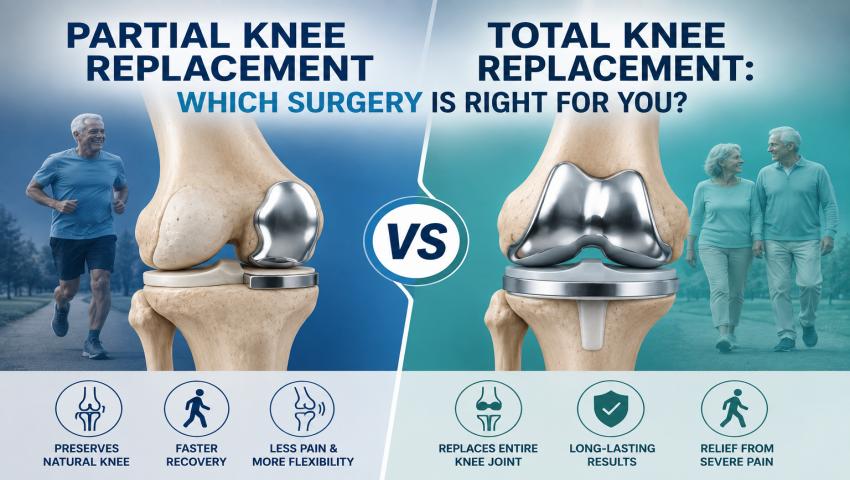
In simple words, the main difference between Partial Knee Replacement vs Total Knee Replacement is the amount of knee joint that is replaced. In a partial knee replacement, only the damaged part of the knee (one compartment) is replaced, while the healthy bone, cartilage, and ligaments are left untouched. In a total knee replacement, the entire knee joint — all three compartments — is replaced with an artificial implant.
Both are common and safe treatment options for patients suffering from severe knee arthritis, but the right choice depends on how much damage your knee has, your age, activity level, and overall health. Naturally, one of the most common questions patients ask is — is knee replacement safe? The good news is yes, when performed by an experienced surgeon under proper medical guidance, knee replacement surgery is considered a safe and highly successful procedure.
This blog, guided by Dr. Ashwini Gaurav, one of the most trusted names when patients search for the best knee replacement surgeon in Patna, will help you understand difference between Partial Knee Replacement vs Total Knee Replacement recovery, risks, implants, and how to decide which surgery is right for you.
What Is Partial Knee Replacement Surgery?
Partial knee replacement surgery is recommended when arthritis or damage is limited to only one section of the knee. Since only the damaged portion is replaced, the surgery involves a smaller incision, less bone removal, and quicker healing compared to a full replacement.
This knee replacement surgery procedure is generally suggested for younger, active patients whose ligaments are still healthy and whose arthritis has not spread across the entire knee.
What Is Total Knee Replacement Surgery?
Total knee replacement procedure involves resurfacing the entire knee joint. The damaged cartilage and bone are removed from the end of the thigh bone, top of the shin bone, and sometimes the kneecap, and replaced with a total knee replacement implant made of metal alloys and medical-grade plastic.
This is usually recommended for patients with widespread arthritis, knee deformity, or significant instability, where a partial fix would not be enough to relieve pain.
Partial Knee Replacement vs Total Knee Replacement: Key Differences
- Extent of surgery: Partial replaces one compartment; total replaces the whole joint.
- Bone and ligament preservation: Partial preserves more natural bone and ligaments (like ACL); total removes more tissue.
- Incision size: Partial knee surgery usually has a smaller cut and is less invasive.
- Recovery: Partial knee replacement generally has a faster knee surgery recovery time.
- Longevity: Total knee replacement implants often have a slightly longer track record for durability in advanced arthritis cases.
- Candidacy: Partial suits localized damage; total suits widespread joint damage.
Comparison Table: Partial vs Total Knee Replacement
Who Is a Good Candidate for Partial Knee Replacement?
You may be a suitable candidate for partial knee replacement surgery if:
- Arthritis is limited to one part of the knee
- Your ligaments, especially the ACL, are healthy and intact
- You are relatively active and want quicker recovery
- Your knee does not have major deformity or instability
Who Needs Total Knee Replacement?
Total knee replacement is usually recommended when:
- Arthritis has damaged most or all parts of the knee
- There is visible bone-on-bone contact on a knee replacement x-ray
- The knee has significant deformity (bow-legged or knock-knee pattern)
- Ligaments are weak, torn, or unstable
- Pain persists even after medication, injections, and physiotherapy
Benefits of Partial Knee Replacement and Benefits of Total Knee Replacement:
Benefits of Partial Knee Replacement:
- Smaller incision and less tissue damage
- Faster knee replacement and recovery time
- More natural knee movement since healthy bone and ligaments are preserved
- Usually less post-operative knee replacement pain
Benefits of Total Knee Replacement:
- Complete relief from arthritis pain across the whole joint
- Long-term durability of total knee replacement implants
- Suitable for more advanced or widespread knee damage
- High overall patient satisfaction and success rate
Risks and Complications of Knee Replacement Surgery:
Like any surgery, knee replacement carries some risks. Total knee replacement complications, though uncommon, may include infection, blood clots, stiffness, implant loosening, or, in rare cases, the need for a total knee replacement revision later in life.
Partial knee replacement carries a slightly different risk — since only part of the knee is treated, arthritis may progress in the untreated area over time, sometimes requiring conversion to a total knee replacement in the future.
Dr. Ashwini Gaurav always advises patients to discuss these risks in detail before surgery, as understanding them helps in making an informed decision and easing post-surgery anxiety.
Partial Knee Replacement vs Total Knee Replacement Recovery Time:
Recovery is one of the biggest deciding factors for most patients.
- Partial Knee Replacement Recovery: Walking with support usually starts within a day, and most patients return to normal daily routine within 3–4 weeks.
- Total Knee Replacement Recovery: Post operative knee replacement care includes physiotherapy starting within 24–48 hours, with full knee replacement and recovery time ranging from 6 weeks to 3 months for complete strength and flexibility.
Post op for knee replacement, both types require regular physiotherapy, wound care, and follow-up X-rays to track healing progress.
Conclusion:
Choosing between partial knee replacement surgery and total knee replacement procedure is not something you should decide alone — it needs a proper clinical evaluation, X-rays, and a detailed discussion with an experienced orthopedic surgeon. As the best orthopedic doctor in Patna, Dr. Ashwini Gaurav at Jeevandan Health OPD focuses on personalised treatment plans, so every patient gets the surgery that truly matches their knee condition and lifestyle needs.
If you are dealing with persistent knee pain, don’t wait for it to worsen. Book a consultation with Dr. Ashwini Gaurav to understand which surgery for knee replacement will work best for you.
FAQ:
Experiencing pain after knee surgery replacement is a completely normal part of the early healing phase. In the initial post operative knee replacement days, discomfort is managed smoothly using modern multimodal analgesia and nerve blocks. The sharp, aching pain after a total knee replacement peaks within the first week and transitions into a manageable, dull ache that fades away as you progress with physical therapy.
The overall knee replacement surgery time varies based on complexity. On average, the physical length of surgery for knee replacement spans between 60 to 90 minutes. A partial procedure is generally quicker, often wrapping up in under an hour, while a comprehensive total knee replacement procedure takes a bit more time to complete.
Surgeons utilize diverse types of knee replacement implants made from advanced materials like titanium, cobalt-chromium alloys, and medical-grade polyethylene. The specific types of implants for knee replacement are selected based on your age, lifestyle, and bone density. Dr. Ashwini Gaurav uses premium, globally recognized total knee replacement implants to ensure maximum durability and highly natural joint movement.
A systematic approach before and after the operation ensures an optimal outcome:
- Pre-Op Preparation: Undergoing physical optimizations, medical clearances, and checking a definitive baseline knee replacement x ray.
- Post-Op Recovery: Actively participating in early mobilization, keeping up with regular post op for knee replacement physiotherapy, and attending scheduled follow-up checkups to monitor implant alignment.
The clinical knee replacement surgery success rate is exceptional, consistently hovering above 95%. This high success rate for knee replacement makes it one of the most reliable and life-improving operations in modern medicine, with high-quality implants easily lasting 20 to 25 years when properly cared for.
Yes, is knee replacement safe is a common question, and the answer is reassuringly positive. Backed by modern anesthesia, minimally invasive approaches, and strict infection controls, the surgery knee replacement holds a phenomenal safety profile. Dr. Ashwini Gaurav conducts meticulous pre-surgical health screenings to maximize safety margins for every patient.
Yes. If arthritis eventually spreads to the remaining healthy sections of the knee years down the line, a partial implant can be converted into a full joint through a specialized total knee replacement revision surgery.
The ideal choice depends entirely on the location and severity of your knee damage. If your arthritis is restricted to a single zone, a partial replacement offers a faster bounce-back. However, if the wear is widespread, a total replacement is the gold standard for lasting relief.